How to Set Up Camp in 20 Minutes: The Exact Routine (With Timed Plan)
# How to Set Up Camp in 20 Minutes: The Exact Routine
You pull into the campground at 6:40 p.m. Sunset is at 7:30. You have fifty minutes of usable light, a car full of gear, and a rumbling stomach. This is the moment that separates a relaxing evening from a stressful one, and the difference is not athleticism or fancy gear. It is having a routine.
Setting up camp in 20 minutes is completely realistic for two people with a practiced order of operations. Your first time will take longer, maybe 40 minutes, and that is fine. By trip three, the routine is muscle memory and you will be sitting in your camp chair with a cold drink while the late arrivals are still arguing about which way the tent door should face.
This guide gives you the exact sequence, minute by minute, plus the home prep that makes it possible, a two-person task split, and adjustments for solo campers, darkness, and rain.
Why 20 Minutes Is Realistic (It Is About Order, Not Speed)
Fast camp setup has almost nothing to do with hurrying. Watch an experienced camper and they do not look rushed. They look bored, because they do the same things in the same order every time. No decisions, no backtracking, no standing around wondering what comes next.
Every minute you lose at a campsite is lost to one of three things: deciding (where should the tent go?), searching (where did I put the stakes?), or redoing (the tent is up but facing the wrong way). A fixed routine eliminates all three. You are not trying to break a speed record. You are removing the friction that turns 20 minutes of work into an hour of faffing.
Before You Leave Home: 3 Things That Make Fast Setup Possible
Speed at the campsite is decided in your driveway. Do these three things and the 20-minute routine works. Skip them and it does not.
1. Practice pitching your tent once at home. The first time you touch your tent should not be at the campground. Set it up in the yard or a park, time yourself, and learn which pole goes where while you are calm and well-lit. This single step saves more time than everything else combined.
2. Pack in setup order, last-in-first-out. The things you need first at camp go in last, on top: tent bag, sleeping gear, then kitchen box, then everything else. If your tent is buried under the cooler and three duffel bags, you have already lost ten minutes.
3. Keep a dedicated camping bin. One bin with the non-perishables that lives packed between trips: stakes, mallet, guylines, lantern, duct tape, first aid, trash bags, dish kit. Restock it when you get home from each trip. Grabbing one bin beats gathering thirty items from around the house.
The 20-Minute Setup Sequence
Here is the full routine as a timed plan. Times assume two people who have pitched the tent at least once before.
| Time | Task | Who |
|---|---|---|
| 0:00-0:03 | Site survey and tent spot selection | Both walk the site together |
| 0:03-0:05 | Unload tent gear to the tent spot; cooler to shade | Person A: tent gear; Person B: cooler + chairs |
| 0:05-0:10 | Pitch the tent (footprint, body, poles, rainfly, stakes) | Both |
| 0:10-0:13 | Sleep setup inside tent (pads, bags, pillows); hang lantern | Person A inside; Person B starts kitchen |
| 0:13-0:18 | Kitchen setup (table/stove, water, food box, waste bag) | Person B (Person A joins at 0:13) |
| 0:18-0:20 | Final touches (chairs out, headlamps placed, site tidy) | Both |
Twenty minutes, camp set, daylight to spare. Now here is what each phase actually involves.
Phase 1: Site Survey (Minutes 0-3)
Do not skip this. Three minutes of looking saves thirty minutes of redoing.
Walk the site together and decide three things. First, where the tent goes: flat ground, no dips where water would pool, clear of large roots and rocks, and at least a tent-length away from the fire ring (sparks eat tent fabric). If the ground slopes slightly, point the tent door downhill or sleep with your head uphill. Second, where the kitchen goes: near the picnic table if there is one, well away from the tent. A good rule is 15 or more feet of separation, which also keeps food smells out of your sleeping area. Third, note the bathroom path, the water spigot, and where you will park for the night.
While you are at it, clear the tent spot of rocks, sticks, and pinecones. Your back will thank you at 2 a.m.
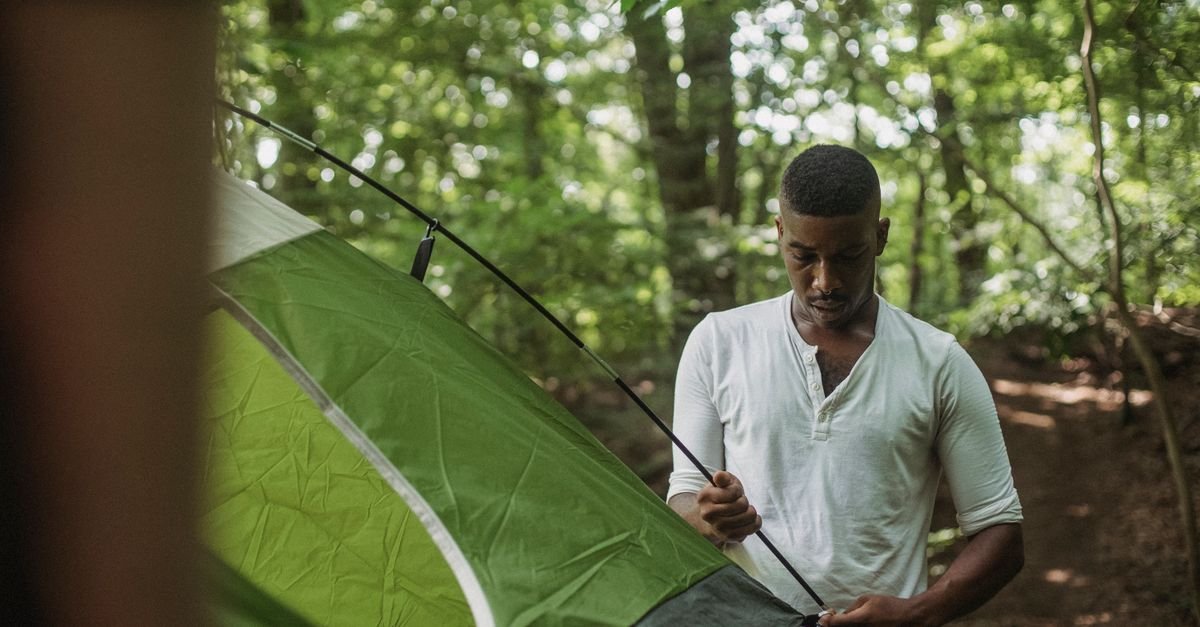
Phase 2: Pitch the Tent (Minutes 3-10)
This is the heart of the routine, and the order never changes:
- Lay the footprint. Groundsheet down first, positioned where the tent will sit.
- Spread the tent body over the footprint, door facing the direction you chose.
- Assemble the poles. Snap or thread them together; keep them off the dirt if you can.
- Raise the tent. Thread poles through sleeves or clip them to the body, then lift. This is the two-person moment: one person holds, the other secures.
- Throw the rainfly over the top and clip it on, even if the sky is clear. Putting it on now takes one minute. Putting it on at midnight in the rain takes twenty and ruins your night.
- Stake the corners first. Drive stakes into the ground at an angle, pointing away from the tent. Taut corners make the whole tent stable.
- Attach guylines and tension them. Tuck any exposed footprint edges under the tent so water cannot pool on them.
Seven minutes is generous once you have done it twice. Most two-person tents go up in under five.
Phase 3: Sleep Setup (Minutes 10-13)
One person ducks inside while the other starts the kitchen. Unroll sleeping pads first, then sleeping bags on top, then pillows. Put tomorrow's clothes and a warm layer inside the tent now so you are not digging through the car in the dark. Hang the lantern from the tent's gear loop and place a headlamp where each person sleeps. Keep a water bottle and any medications within arm's reach of your sleeping spot.
This is also the moment to change into dry camp clothes if you hiked in. Future you, the one crawling into the tent at 10 p.m., will appreciate past you enormously.
Phase 4: Kitchen Setup (Minutes 13-18)
The second person has a head start here. The kitchen routine:
- Table and stove. Set up the camp table or claim the picnic table; place the stove on a stable, level surface away from anything flammable.
- Water staged. Put the water container where you can reach it without moving. Fill a pot or kettle now if dinner needs water.
- Food box and cooler. Cooler stays in the shade with the lid closed as much as possible. Dry food box nearby.
- Waste bag clipped. Hang or clip a trash bag at the kitchen station immediately. If the bag exists from minute one, trash goes in the bag instead of on the table.
- Dish kit out. Soap, sponge, basin, and towels in one spot.
Five minutes for the kitchen is the "five-minute kitchen" rule: everything has a fixed home, so there is nothing to decide.
Phase 5: Final Touches (Minutes 18-20)
Chairs out and facing the fire ring or the view. Headlamps checked and placed (one per person, plus the lantern). Firewood stacked near the ring if fires are allowed and you bought wood. Quick site tidy: nothing left in the car that you will need before morning except valuables and food, which stays locked in the car overnight.
Then sit down. You are done. Twenty minutes, and the evening is yours.
Two-Person Task Division
The timed plan above splits naturally. Person A owns shelter: tent spot, tent pitching, interior setup. Person B owns logistics: cooler to shade, kitchen setup, water, waste. Both do the site survey together, both pitch the tent (it is genuinely a two-person job for most tents), and both do final touches. The key insight is that Person B starts the kitchen while Person A finishes the tent interior, so nobody stands around waiting.
If one of you is experienced and the other is new, the experienced person should take the tent and narrate what they are doing. By the second trip, the new camper can pitch it solo.
Solo Setup Adjustments
Solo campers can absolutely hit 20 minutes with two adjustments. First, choose a smaller, simpler tent; a 2-person tent pitches much faster alone than a 6-person cabin tent. Second, do everything in strict sequence instead of parallel: survey, tent, interior, kitchen, touches. It will take closer to 25 minutes, and that is fine. The routine still eliminates the decision-making that eats time.
One solo-specific tip: stake one corner of the tent before raising it. That anchored corner holds everything in place while you work the poles, which is the part that normally wants a second pair of hands.
Setting Up in the Dark (The Backup Plan)
Sometimes you arrive late despite your best plans. Do not panic; just change the order. Put headlamps on immediately, before you unload anything. Set up the tent first, everything else second, because shelter matters more than kitchen organization. Skip the full kitchen: eat sandwiches or snacks, and do the real cooking setup in the morning. Keep the site minimal tonight and dial it in tomorrow. A dark setup done calmly beats a rushed setup done frantically every time.
Rain Setup: What Changes When It Is Wet
If it is raining when you arrive, speed matters more and the order shifts slightly. Get the rainfly up as fast as possible: some campers pitch the footprint and rainfly first, then assemble the tent body underneath it. Keep sleeping bags and clothes in dry bags or trash bags until the tent is fully up and staked. Set up a tarp over the kitchen area before unpacking any food. And change into dry clothes the moment the tent is ready; sitting in wet clothes while you finish setup is how trips get miserable.
The good news: rain at arrival often means a cozy evening in a dry tent, which is one of camping's great pleasures. The bad news only comes if you dawdle.
The 10-Minute Teardown (Morning Reverse Routine)
Fast setup earns you a fast teardown if you reverse the order. Here is the morning version:
| Time | Task |
|---|---|
| 0:00-0:03 | Breakfast and coffee; stuff sleeping bags while the stove cools |
| 0:03-0:06 | Deflate pads, pack tent interior, shake out the tent |
| 0:06-0:09 | Drop the tent (rainfly off, poles out, fold), pack kitchen |
| 0:09-0:10 | Final sweep: check the whole site for trash and forgotten items |
Two rules make teardown fast. First, everything goes back where it came from: the camping bin gets its items, the tent bag gets the tent. Second, never pack a wet tent into its stuff sack and forget about it. If you must pack it damp, set it up to dry within a day of getting home, or it will mildew.
Mistakes That Cost You 30 Minutes
- Unloading everything before deciding where the tent goes. Survey first, unload second.
- Pitching the tent, then moving it. The door faces the wrong way, the ground slopes, the fire ring is too close. Three minutes of surveying prevents this.
- Digging for stakes and poles. Keep tent parts together in the tent bag. Always.
- Setting up the kitchen before the tent. If weather turns or light fails, shelter beats dinner prep.
- Letting the cooler sit in the sun. Ice melts, food warms, and now you have a problem. Shade first, always.
- No headlamp within reach. The moment you need light and do not have it, everything stops.
Frequently Asked Questions
Can I really set up camp in 20 minutes as a beginner?
On your very first trip, plan for 35-45 minutes and do not stress about it. The 20-minute routine is a realistic target by your second or third trip, once you have pitched the tent before and packed in setup order. Think of it as a skill that compounds, not a test you pass on day one.
What is the most important step to not skip?
Staking the tent and putting on the rainfly, even in good weather. An unstaked tent becomes a kite in a surprise gust, and a missing rainfly turns a 2 a.m. rain shower into an emergency. Both take minutes when done during setup and feel impossible when done in a crisis.
How far should my kitchen be from my tent?
Well away from your sleeping area: 15 or more feet is a good rule. This keeps food smells out of the tent, which matters for everything from midnight raccoon visits to bear safety in bear country. Cook, eat, and store food away from where you sleep.
Should I set up the tent or the kitchen first?
The tent, always. Shelter is the priority: if light fades or weather arrives, you need somewhere dry to be. The kitchen can be minimal on night one (sandwiches, snacks) and properly set up in the morning.
What if the ground is too hard for stakes?
Rocky or hard-packed ground is common at established campgrounds. Push stakes in at an angle with a mallet or rock; if they will not go, tie guylines to heavy rocks, logs, or the picnic table instead. In sandy soil, use longer stakes or bury a "deadman" anchor (a stick or rock tied to the guyline, buried in the sand).
How do I pick a tent spot at a campground?
Look for the flattest, most sheltered part of your site, away from the fire ring and not in a low spot where water would collect. Avoid pitching under dead branches. Check where the morning sun will hit: a tent in full early sun becomes an oven by 7 a.m., which is either a feature or a bug depending on your wake-up preferences.
Make It a Ritual, Not a Chore
The real payoff of the 20-minute routine is not the saved time. It is the feeling of rolling into camp and knowing exactly what happens next. No stress, no debate, no daylight wasted. Tent up, kitchen running, chairs out, and the whole evening ahead of you. Do it the same way three times and it stops being a routine and starts being a ritual: the way your weekends begin.
Time yourself on the second trip, not the first. Knowing your real setup time helps you plan arrival times honestly, especially when daylight is short. Most campers are surprised to find they beat the 20-minute mark sooner than expected.