What to Do If You Get Lost While Hiking: Stay Safe and Get Found
# What to Do If You Get Lost While Hiking: Stay Safe and Get Found
It is Saturday morning. You took a wrong turn at a trail junction, the trees all look the same, and the trail you were following has quietly disappeared under the leaves. Your stomach drops. Getting lost while hiking is frightening, and it happens to experienced hikers too, not just beginners.
Here is the good news: most lost-hiker situations are resolved quickly when the hiker does a few simple things right. This guide walks you through exactly what to do if you get lost while hiking, from the moment you realize you are off track to the moment help finds you.
Getting Lost Happens More Often Than You Think
Almost every lost-hiker story starts the same way. Someone steps off the trail for a photo, takes a shortcut that is not a shortcut, or follows a game trail that looked like the path. The trail does not vanish all at once. You just gradually stop noticing markers, and by the time you admit something is wrong, you have been walking the wrong way for twenty minutes.
The most dangerous thing about being lost is not the forest. It is panic. A panicked hiker keeps moving, walks faster, and wanders farther from the area where searchers will look first. Wilderness safety educators teach that the errors that get hikers into real trouble usually happen in the first panicked minutes after realizing they are lost, not in the hours after. So the single most important skill in this entire guide is the ability to stop, calm yourself, and think clearly. Everything below builds on that.
The STOP Method: Your First Move When You Are Lost
Wilderness safety training programs, including the guidance published by the US Forest Service, teach a simple four-step protocol for the moment you realize you may be lost. It is called STOP: Stop, Think, Observe, Plan. Memorize these four words before your next hike.
| Letter | Step | What to do |
|---|---|---|
| S | Stop | Stop walking the instant you suspect you are lost. Sit down. Do not take another step until you have calmed your breathing and assessed the situation. |
| T | Think | Think back over your hike. When was the last time you knew exactly where you were? What landmarks did you pass? How much daylight, water, and food do you have left? |
| O | Observe | Observe your surroundings. Look for your own footprints, trail markers, blazes on trees, ridgelines, streams, and familiar landmarks. Pull out your map, compass, or phone. |
| P | Plan | Plan your next move based on facts, not fear. If you can confidently retrace your steps a short distance to your last known location, do it. If you cannot, staying put is usually the safest choice. |
Here is each step in more detail.
Stop
The hardest step and the most important one. Your instincts will scream at you to keep moving, that the trail must be just around the next bend. It probably is not, and every step you take while disoriented likely carries you farther from the trail and from the area where searchers will start looking. Sit down, drink some water, and take slow breaths until your hands stop shaking. As the US Forest Service puts it, panic is your greatest enemy, and a positive mental attitude is your most important survival tool.
Think
Ask yourself: when did I last know my location for certain? What was the last trail junction, blaze, or landmark? Take stock of practical facts: what time is it, how many hours of daylight remain, how much water and food do you have, what is the weather doing, and is anyone expecting you home by a certain hour?
Observe
Look around carefully before you move. Can you see or hear the trail behind you? Are there footprints, cairns, blazes, or cut logs? Is there higher ground nearby where you could get a better view? Pull out your navigation tools. A paper map and compass work even when your phone does not, which is exactly why they sit at the top of every gear list.
Plan
Now decide. You have only a few honest options: retrace your steps to your last known point, stay put and signal, or in rare cases, attempt a careful self-rescue. The next section explains how to choose.
Should You Stay Put or Try to Get Out Yourself?
This is the biggest decision a lost hiker faces, and the wrong choice is the reason many searches drag on for days. The general rule taught by search and rescue professionals is simple: if you cannot confidently retrace your steps, stay put. A stationary target is far easier to find than a moving one, and wandering expands the search area with every mile.
Backtracking is reasonable only if you know exactly where you left the trail, it was recent, you can see a clear way back, and you have enough daylight, water, and energy. If doubt grows as you walk, stop again immediately.
If any of those are shaky, stay where you are. Settle in, make yourself visible, and start signaling. Staying put is not giving up. It is the strategy that gets most lost hikers found.
There are a few situations where moving on is the better call: you are on or near a trail and can follow it confidently downhill toward a road or trailhead, you are in immediate danger where you stand (a rising stream, an exposed ridgeline in lightning, an unstable slope), or you told no one where you went and have no way to signal. In that last case, move deliberately: follow drainages or streams downhill, mark your path as you go so you can backtrack, and stop to signal and rest at regular intervals.
One more point: if you are hiking with other people, stay together. Splitting up doubles the number of people who need rescuing and halves everyone's chances.
How to Signal for Help So Searchers Can Find You
Once you have decided to stay put, your job changes from navigating to being found. Work through these signaling methods, starting with the easiest:
- Blow your whistle in threes. Three short blasts, a pause, then three more. The three-blast pattern is the widely recognized international distress signal. A whistle carries much farther than your voice, uses almost no energy, and works in the dark and in thick forest. Keep the whistle on your person, not buried in your pack.
- Make yourself visible. Move to the most open spot nearby. Spread out bright clothing and gear to create a patch of color that contrasts with the forest floor. Drape a bright jacket over a branch at head height. Movement and contrast catch the eye, especially from the air.
- Use a signal mirror. On a sunny day, a signal mirror can flash sunlight to aircraft and distant searchers. Aim the reflection toward the sound of a plane or helicopter. Any flat reflective surface works in a pinch, including a phone screen.
- Build a ground signal. Arrange rocks, logs, or gear into a large X or SOS on open ground, big enough to be seen from the air. Three of anything (three fires, three piles of gear, three flashes) reads as a distress pattern.
- Light a signal fire only if it is safe and legal. A smoky fire by day and a bright fire by night are powerful signals. Use green boughs to make thick smoke during daylight. Never build one during fire restrictions or high wind, and keep it small.
- Use your headlamp at night. Flash it in groups of three toward any sound of searchers or aircraft. The strobe setting, if your headlamp has one, is designed for exactly this.
Signal in bursts and then listen. After each round of whistle blasts or shouts, go quiet and listen for a reply. Searchers may answer with their own whistle blasts.
How to Conserve Your Phone Battery When It Matters Most
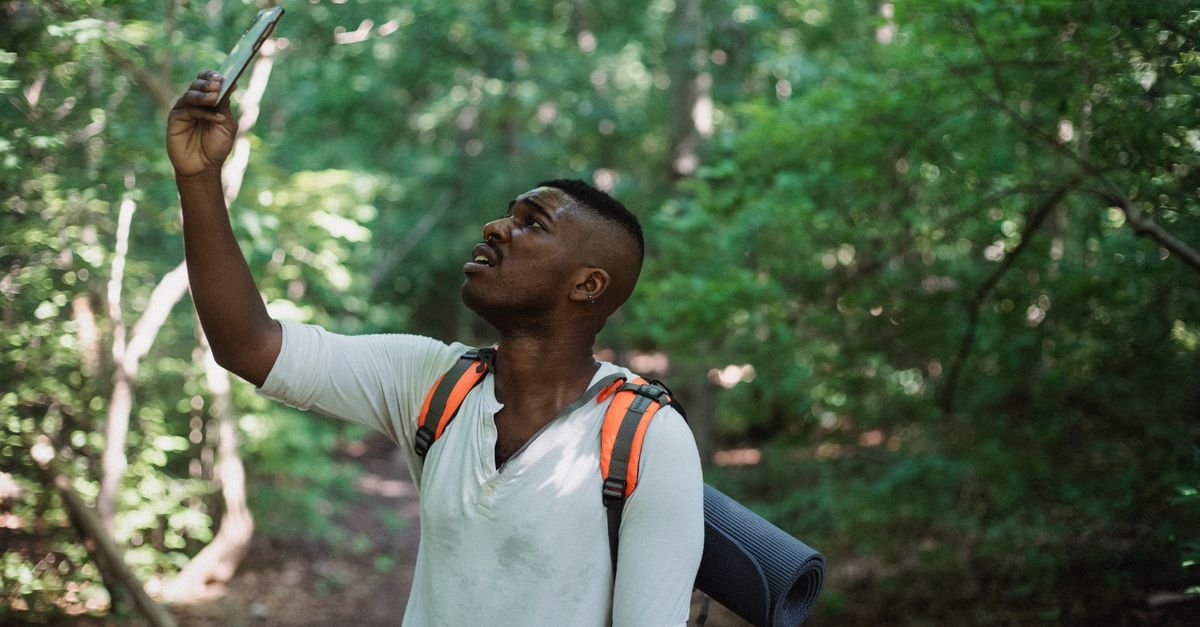
Your phone is a powerful tool when you are lost: it can show your location, call or text for help, and flash a light. It is also a battery with a hard limit, and a dead phone helps no one. The moment you realize you are lost, switch your phone into survival mode.
- Turn on airplane mode or low power mode immediately. Your phone burns energy searching for a signal it cannot find. Airplane mode stops that drain. You can toggle it off briefly to try a call or check your location, then turn it back on.
- Dim the screen and shorten the screen timeout. The display is the biggest battery hog. Drop brightness to minimum and set the screen to sleep quickly.
- Close every app you do not need. Navigation, camera, and social apps drain power in the background. Keep only your map app and messaging.
- Keep the phone warm. Cold saps batteries fast. Tuck the phone in an inside pocket close to your body.
- Try 911 even with no bars. In the US, emergency calls can connect through any available carrier network, not just your own. If a call will not go through, try a text to 911, which is supported in many areas and uses far less signal. Text messages can also sometimes send when calls cannot.
- Send one clear message, then stop. If you reach anyone, send your situation, your last known location, your battery level, and your plan ("staying put at the meadow past the creek crossing"), then go quiet and conserve power. Do not stay on the phone chatting.
If you carry a portable charger, this is the day it earns its place in your pack.
What to Do After Dark
Nightfall changes the equation. Moving in the dark multiplies every risk: ankle injuries, wrong turns, drop-offs you cannot see. Unless you are on a clear trail very close to the trailhead, the right move after dark is to stop moving, settle in, and wait for morning.
Your priorities after dark, in order:
- Stay warm. Put on every layer you have. Hypothermia is the real killer in lost-hiker situations, and it can set in on a mild evening once you stop moving. Insulate yourself from the ground with your pack, dry leaves, or pine boughs.
- Stay dry. Get out of the wind and rain if you can. A simple emergency bivy, space blanket, or even a large trash bag can make the difference between a miserable night and a dangerous one.
- Stay visible and audible. Keep your whistle and headlamp within arm's reach. Flash your headlamp in groups of three if you hear searchers or aircraft. A small, controlled campfire provides warmth, comfort, and a signal all at once, where it is safe and permitted.
- Ration calmly. Eat something and sip water through the night. You do not need to hoard every drop; a clear head and a functioning body matter more than a full bottle in the morning. Sip steadily rather than gulping.
- Rest if you can. You do not need real sleep. Sitting still, staying warm, and conserving energy is enough. Morning brings light, better visibility for searchers, and a fresh chance to think clearly.
How the Ten Essentials Keep This From Happening to You
Most lost-hiker emergencies are really gear emergencies in disguise. The hiker who gets found quickly is usually the hiker who packed well, and the classic framework for packing well is the Ten Essentials. Originally assembled in the 1930s by The Mountaineers, a Seattle-based climbing club, and popularized by REI's Expert Advice guides, the list has evolved into ten systems that cover everything that can go wrong outdoors, including getting lost.
| Essential system | What to carry | How it helps when you are lost |
|---|---|---|
| Navigation | Map, compass, GPS device or app, plus a power bank | Lets you relocate yourself instead of guessing; a paper map and compass work with zero battery |
| Headlamp | Headlamp plus extra batteries | Lets you signal at night and move safely if you must |
| Sun protection | Sunglasses, sunscreen, sun-protective clothing | Prevents sunburn and snow blindness during a long unexpected day out |
| First aid | Kit with blister care, bandages, any personal medication | Treats the small injuries that happen when you are tired and clumsy |
| Knife and repair kit | Knife or multitool, duct tape | Repairs gear, cuts cordage, prepares tinder and shelter materials |
| Fire | Lighter, waterproof matches, tinder | Warmth, comfort, and your strongest night signal |
| Emergency shelter | Lightweight bivy, space blanket, or tarp | Keeps you warm and dry through an unplanned night out |
| Extra food | More than you expect to need | Keeps your energy and judgment intact while you wait |
| Extra water | More than you expect to need, plus a treatment method | Keeps you hydrated; a filter or tablets make stream water safe |
| Extra clothes | Insulating layer, rain shell, warm hat, spare socks | Your main defense against hypothermia after dark |
Notice how the first item, navigation, is the one that prevents the situation entirely, while fire, shelter, extra food, water, and clothes are the ones that turn a lost night into an uncomfortable story instead of an emergency. You do not need expedition-grade versions of any of this. A printed map, a basic compass you have practiced with, a whistle, a headlamp, a lighter, and an inexpensive emergency bivy fit in any daypack and weigh almost nothing. If you hike often beyond cell coverage, a satellite communicator or personal locator beacon can send an SOS with your GPS coordinates from anywhere.
Prevention Checklist: Before Every Hike
The best lost-hiker strategy is never becoming one. Run through this checklist before you leave home, every single time, even for the easy trail you have done ten times:
- [ ] Tell someone your plan. Give a specific person your trailhead, route, expected return time, and when to call for help if you are overdue. This single step does more for your rescue chances than any gear.
- [ ] Carry a map and know how to read it. Download offline maps too, but bring paper as backup. Check the route against the map at every junction.
- [ ] Bring a compass and know how to use it. Practice in a park before you need it on a mountain.
- [ ] Pack the Ten Essentials. Every hike, every time, even short ones.
- [ ] Carry a whistle. Clip it to your pack strap or keep it in a pocket, not at the bottom of your bag.
- [ ] Check the weather and daylight. Know sunset time and turn back with a generous margin. Most navigation errors happen when hikers rush against fading light.
- [ ] Charge your phone and bring a power bank. Start every hike at 100 percent.
- [ ] Check in at junctions. Pause at every trail split, confirm it matches your map, and note your direction of travel.
Frequently Asked Questions
Should I keep walking if I am lost while hiking?
No, not unless you are certain of the way back. Stop as soon as you realize you are lost and use the STOP method: Stop, Think, Observe, Plan. If you can confidently retrace your steps a short distance to your last known location, do that. Otherwise, stay put, because wandering expands the search area and makes you harder to find.
What is the STOP method for getting lost?
STOP stands for Stop, Think, Observe, Plan: stop walking immediately, think back over your route and resources, observe your surroundings and check your navigation tools, then plan your next move based on facts rather than panic.
How do I signal for rescue if I am lost?
Blow a whistle in three short blasts, pause, and repeat. Make yourself visible with bright clothing in an open area. Use a signal mirror to flash sunlight toward aircraft. Arrange rocks or gear into a large X or SOS visible from the air. At night, flash a headlamp in groups of three.
Will my phone work if I am lost with no signal?
Possibly. Emergency calls to 911 in the US can connect through any available carrier network, not just your own, and text-to-911 works in many areas and needs less signal than a call. Conserve battery with airplane mode and low brightness, try from high open ground, and send one clear message with your location and plan if you get through.
How can I avoid getting lost on a hike in the first place?
Tell someone your exact plan and return time, carry a map and compass you know how to use, stay on marked trails, check your position at every junction, and pack the Ten Essentials. Most people get lost by drifting off trail without noticing, so pausing to confirm your location regularly is your best defense.
The Bottom Line
Getting lost while hiking is scary, but it is also survivable, and usually quickly resolved, when you respond calmly and correctly. Memorize STOP. Stay put unless you are sure of the way back. Signal in threes. Protect your phone battery. Settle in safely if night falls. And before your next hike, pack the Ten Essentials and tell someone where you are going, because the hiker who is easiest to rescue is the one who prepared to be found. See you out there.