What to Do If You See a Bear While Hiking: A Calm, Step-by-Step Guide
You are three miles into a Saturday hike, earbuds in, thinking about absolutely nothing, when you round a bend and there it is: a bear. Your heart hammers, your hands go cold, and every nature documentary you have ever half-watched floods back at once.
Take a breath. Bear encounters are far less dangerous than they feel, and almost all of them end with the bear walking away and the hiker getting a great story. The National Park Service's core guidance is worth memorizing before you ever lace up your boots: stay calm, do not run, make yourself look large, speak to the bear in a calm voice, and back away slowly while keeping the bear in sight.
That said, the details matter enormously, because the correct response to a black bear is the opposite of the correct response to a grizzly bear. Get that one fact straight and you already know more than most weekend hikers. This guide walks you through exactly what to do, step by step, in the order you would need it.
The Short Answer: Your Bear Encounter Action Plan
If you only remember one section of this article, make it this one. Here is what to do the moment you spot a bear:
- Stop and stay calm. Freeze for a second and assess. Do not scream, do not bolt, and do not turn your back. Panic is the one response that reliably makes things worse.
- Do NOT run. Bears can sprint over 30 miles per hour, and running can trigger a chase response. You will not outrun a bear, and you do not need to.
- Make yourself look large. Stand tall, raise your arms or trekking poles overhead, and open your jacket wide if you are wearing one. You want to look like a big, difficult animal, not easy prey.
- Speak calmly and firmly. Talk in a low, steady voice: "Hey bear, I am a human, I am leaving." This tells the bear what you are (bears do not instinctively recognize humans) and calms your own nerves at the same time.
- Back away slowly. Move sideways or backward at an angle, never turning your back. Keep facing the bear and give it a clear escape route. Most bears want distance just as much as you do.
- Get your bear spray ready. If you are in bear country, your spray should already be on your hip or chest strap, not buried in your pack. Remove the safety clip and hold the canister with two hands.
- Give it space. In parks like Yellowstone and Glacier, regulations require staying at least 100 yards (a football field) from bears. If the bear has not noticed you, detour widely behind and downwind of it.
Most encounters end right there. The bear notices you, decides you are not interesting, and ambles off. But if the bear approaches, charges, or makes contact, what you do next depends entirely on which species you are looking at.
Black Bear vs Grizzly: Why the Species Changes Everything
Here is the single most important thing to understand about bear safety: the correct response to an attack is opposite for the two species.
- Grizzly or brown bear attack (defensive): play dead. Grizzlies usually attack to neutralize a perceived threat to their cubs or food. Playing dead convinces the bear the threat is gone, and the attack typically stops.
- Black bear attack: fight back. Black bear attacks on humans are more often predatory. Playing dead removes your only defense. Fight back with everything you have.
This inversion is why learning to tell the two species apart is worth your time before a trip. In much of the United States, especially the East, the Midwest, and the South, any bear you see will be a black bear. Grizzlies live primarily in Alaska, parts of the northern Rockies (Yellowstone, Glacier, the Bob Marshall Wilderness), and pockets of the Pacific Northwest. But ranges overlap in places, and misidentification is common, so learn the field marks.
How to Tell a Black Bear from a Grizzly Bear
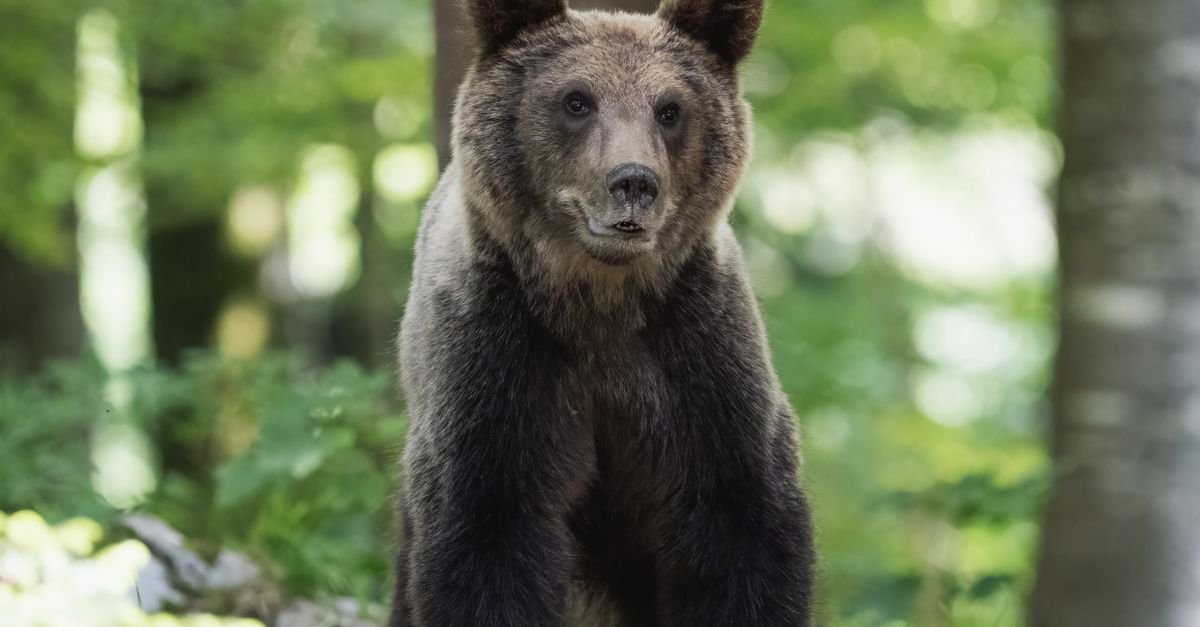
Do not rely on color. This is the mistake almost everyone makes. Black bears can be brown, cinnamon, blond, or even grayish, and grizzlies can be nearly black. Roughly half of black bears in the Rocky Mountains are not black at all. Instead, look at the combination of features below, which is exactly how the National Park Service and Parks Canada teach identification.
| Feature | Grizzly / Brown Bear | Black Bear |
|---|---|---|
| Shoulder hump | Prominent muscular hump; highest point of the body | No hump; back is level or slopes down from shoulders |
| Rump vs shoulders | Rump sits lower than the shoulders | Rump sits higher than the shoulders ("rear in the air") |
| Face profile | Dished or concave between eyes and snout | Straight line from forehead to muzzle |
| Ears | Short, round, blend into the head | Tall, oval, prominent and erect |
| Front claws | Long (2 to 4 inches), light-colored, slightly curved | Short (under 2 inches), dark, strongly curved |
| Size on all fours | 3 to 5 feet at the shoulder | 2 to 3.5 feet at the shoulder |
| Climbing | Adults rarely climb trees | Excellent climbers at every age |
In the field, the hump and the rump line are your fastest tells. If you can see a muscular hump on the shoulders and the rear end sits low, you are looking at a grizzly. No hump and a high rump means black bear. When in doubt at a distance, it does not matter much: the "seen at a distance" response is identical for both species. Back away and give it space.
The Moment-by-Moment Playbook: What to Do as Things Escalate
Bear encounters usually follow a predictable arc. Here is how to respond at each stage, broken out by species where it matters.
| Situation | Black Bear | Grizzly / Brown Bear |
|---|---|---|
| Spotted at a distance | Back away slowly, give it space, detour if possible | Back away slowly, give it space, detour if possible |
| Bear notices you | Stand your ground, look large, speak calmly and firmly | Stand your ground, look large, speak calmly |
| Bear approaches or huffs, jaw-pops, stomps | Be assertive: yell, bang trekking poles, get big. Ready your bear spray | Stand your ground, speak calmly, ready your bear spray. Do not act aggressively |
| Bear charges | Stand your ground and deploy bear spray when it is within 60 feet. Most charges are bluffs | Stand your ground and deploy bear spray when it is within 60 feet. Most charges are bluffs |
| Bear makes contact | Fight back. Hit the face and muzzle with fists, rocks, sticks, trekking poles. Do NOT play dead | Play dead. Lie face down, lace hands behind your neck, spread your legs, keep your pack on. Stay still and silent until the bear leaves, then wait several minutes |
| Attack continues or bear is feeding on you | Keep fighting back | Fight back with everything you have |
| Bear stalks you or enters your tent | Fight back. This signals predatory intent. Do not play dead | Fight back. Same rule: predatory behavior overrides the play-dead guidance |
A few notes on the details that save lives:
Playing dead, done right: Drop to the ground face down. Lace your fingers behind your neck, tuck your elbows in, and spread your legs wide so the bear cannot easily flip you over. Keep your backpack on; it shields your back. Stay still and silent until the bear leaves, then wait several minutes before moving, since bears sometimes linger nearby.
Fighting back, done right: This is not about winning a fight with a bear. It is about convincing the bear you are more trouble than you are worth. Yell, throw rocks, swing trekking poles or a heavy branch, and aim for the face and muzzle, the most sensitive areas. Black bears that meet fierce resistance often break off the attack.
The predatory exception: If any bear, of either species, stalks you quietly with ears erect, follows you deliberately, or enters your tent at night, treat it as predatory. Do not play dead. Fight back and try to get into a vehicle or building if one is reachable. The National Park Service is explicit: a bear that stalks you first or attacks in your tent should be fought, regardless of species.
Bear Spray: How to Carry It and Actually Use It
Bear spray is the single most effective tool you can carry in bear country. The National Park Service recommends carrying it whenever you hike where bears live, and it has an excellent track record of stopping charging bears when used correctly. But a canister at the bottom of your pack might as well be at home. Here is how to do it right.
Buy the right product. Bear spray is not the same as personal pepper spray for self-defense. Buy a canister clearly labeled for deterring bear attacks, ideally one registered with the EPA. Interagency guidelines suggest a minimum of about 7.9 ounces (225 grams), a range of at least 25 feet, and spray duration of at least 6 seconds. Check the expiration date before every season and replace expired cans; pressure fades over time.
Carry it where you can reach it. On a belt holster or chest strap, every single time. Never inside your pack, never in a side pocket you have to dig through. Practice drawing it the way you would practice anything that matters under pressure.
Know when to spray. The National Park Service advises deploying bear spray when an aggressive, charging bear is within about 60 feet. Do not spray a distant bear that has not noticed you; you will just waste the can and possibly irritate it. Do not wait until the bear is on top of you either, because at that range the spray is as likely to hit your own face as the bear's.
Know how to spray. Remove the safety clip, point the canister slightly downward, and spray a cloud between you and the bear so the animal runs into it. Be ready to spray in bursts or empty the entire can if the bear keeps coming. Account for wind: spray with the wind at your back when possible, and never spray into the wind unless you have no choice.
Practice before you need it. Buy an inert training canister (filled with water, no capsaicin) and practice the full sequence in your backyard: draw, remove safety, aim, spray. Under adrenaline, you will perform exactly at the level you have practiced.
Check local regulations. Some parks restrict or prohibit bear spray, so check the rules for your specific destination before you go. A few California national parks, for example, do not allow it. Where spray is not an option, lean harder on the prevention habits below.
Bluff Charges: The Scariest Thing That Is Usually Nothing
A bear may charge directly at you, full speed, head low, and then veer off or stop short at the last second. This is a bluff charge, and bears use it to test whether you are a threat. It is terrifying and it is also the most common outcome of a close encounter.
The rule for bluff charges is the same as for real ones: stand your ground. Running turns a bluff into a chase, because a fleeing animal looks like prey. Keep your bear spray ready, keep facing the bear, and keep talking in a low, firm voice. Signs a bear is stressed and might charge include huffing, jaw-popping (a loud clacking sound), swaying its head, and stomping its paws. If you see these, the bear is telling you to back off, so do exactly that, slowly.
You cannot reliably tell a bluff charge from a committed charge while it is happening, which is why the response is identical: stand your ground, spray at 60 feet, and prepare to play dead or fight back only if contact actually occurs.
Preventing Encounters: 9 Bear-Smart Hiking Habits
The best bear encounter is the one that never happens. Almost every negative encounter starts with a surprised bear, and surprise is preventable.
- Make noise on the trail. Most attacks happen during surprise encounters at close range. Talk, clap, or call out "hey bear" regularly, especially near streams, blind corners, thick brush, and berry patches. Human voices carry better than bear bells, which many experts consider too quiet to be useful.
- Hike in groups. The National Park Service recommends groups of three or more in grizzly country. Groups are noisier, look bigger, and are dramatically less likely to be involved in incidents. Solo hikers should be extra vocal.
- Stay on maintained trails. Trails are predictable corridors. Bushwhacking through dense vegetation is where surprise encounters happen.
- Avoid dawn, dusk, and nighttime hiking in bear country. Bears are most active in the cooler hours. Plan to be back at the trailhead well before sunset.
- Watch for bear sign. Fresh scat, tracks, diggings, torn-up logs, and ripped-open anthills all mean bears are active nearby. Be extra alert, make extra noise, and consider turning around if sign is very fresh.
- Never get between a mother and her cubs. This is the classic trigger for defensive grizzly attacks. If you see cubs, the mother is nearby, and you should leave the area immediately and calmly.
- Manage your food and scented items. Store food, trash, sunscreen, and scented toiletries in bear-proof containers or hung well away from where you sleep. Cook and eat away from your tent. Never keep food in your tent.
- Keep dogs leashed or leave them home. An off-leash dog can provoke a bear and then run back to you, bringing the bear with it. In grizzly country, this is genuinely dangerous.
- Report sightings to rangers. Your report helps land managers track bear activity and warn other hikers. If a bear is behaving aggressively or seems food-conditioned, reporting it can prevent someone else's bad day.
What Most People Get Wrong About Bears
Myth: Bears are out to get you. Reality: bears generally avoid people. The vast majority of encounters end with the bear leaving. Black bears in particular are often timid and will flee from assertive humans.
Myth: Climb a tree to escape. Reality: black bears are superb climbers and grizzlies can climb too. Climbing puts you in a worse position, not a better one.
Myth: Bear bells are enough protection. Reality: bells are quiet, and some bears may associate the sound with hikers carrying food. Your voice is louder and more clearly human.
Myth: You can tell the species by color. Reality: black bears come in brown, cinnamon, and blond; grizzlies can be dark. Use the hump, ears, face profile, and rump line instead.
Myth: Play dead for every bear. Reality: playing dead is for defensive grizzly attacks only. For black bears, and for any predatory attack, fight back.
Myth: A bear standing on its hind legs is about to attack. Reality: bears stand up to see and smell better. It is curiosity, not aggression. Stay calm and keep doing what you are doing.
Frequently Asked Questions
What should I do if I see a bear but it has not seen me? Stay quiet, keep out of sight, and detour as far around it as possible, ideally downwind so your scent does not carry toward it. If you cannot detour safely, wait for the bear to move on, then back away slowly and leave the area. This is the best-case scenario, so enjoy the rare sighting from a safe distance.
How close is too close to a bear? If your presence changes the bear's behavior, you are too close. As a rule of thumb, parks like Yellowstone and Glacier require at least 100 yards (about a football field) between people and bears, and approaching closer is prohibited. Use binoculars or a zoom lens, not your feet, to get a closer look.
Should I carry bear spray on every hike? In bear country, yes. The National Park Service recommends it as standard equipment wherever bears live. Outside known bear habitat, it is generally unnecessary weight. Check whether you will be in black bear or grizzly territory before your trip, and check park regulations since a few parks restrict bear spray.
What does a bluff charge look like? The bear runs directly at you with its head low, often huffing, and then stops short or veers away at the last moment. It feels completely real, which is the point: the bear is testing you. Stand your ground, keep your spray ready, and do not run.
Can I hike alone in bear country? It is legal in most places but riskier. The National Park Service recommends groups of three or more where grizzlies live. If you go solo, be extra diligent: make constant noise, carry bear spray accessibly, stick to popular trails in daylight, and tell someone your exact plan.
What should I do after a bear encounter? Leave the area calmly, then report the encounter to park rangers or the local land manager as soon as you can. Note the species, size, behavior, location, and time. Your report helps keep the next hiker safe.
A Quick Disclaimer
Bear behavior is unpredictable, and no guide can cover every situation. This article summarizes guidance from the National Park Service, Parks Canada, and wildlife agencies, but conditions vary by region, season, and individual animal. Always check the specific guidance from the land manager for the park or forest you are visiting before you go, and consider a bear safety course if you will be hiking regularly in grizzly country.